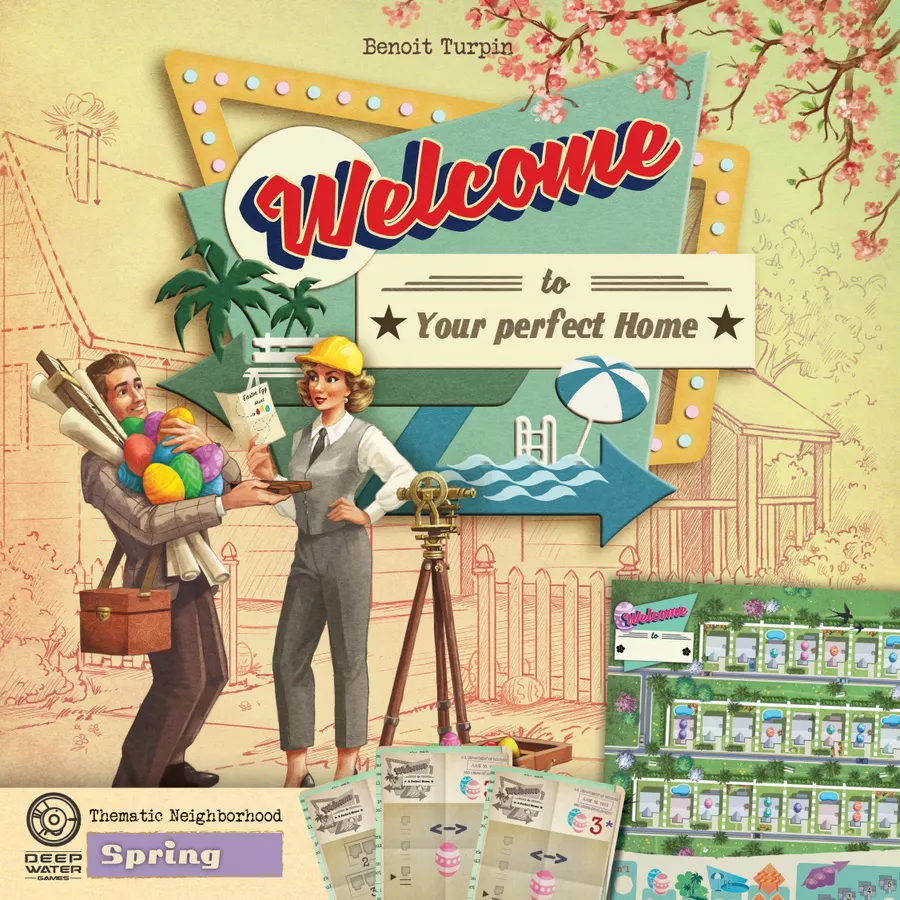
🐣 Welcome To…: Spring Neighbourhood
📦 What's New
Spring adds an Easter egg hunt layer on top of the base game. The expansion includes:
- 50 new score sheets — houses now have Easter eggs printed on them (1 or 2 eggs per house)
- Egg collection mechanic — collect eggs by writing "loop" numbers on houses with eggs
- 3 new City Plan cards — tied to egg collection milestones
- New scoring row — bonus points for total eggs collected (big bonuses at 14 and 18)
🔀 Rule Changes — Egg Collection
Houses on the Spring score sheet have Easter eggs printed on them (some have 1 egg, some have 2, many have none). When you write a house number on a space with eggs, you collect those eggs only if the number contains a "loop" — a closed circle in its digit(s).
What is a "loop" number? Any digit that contains an enclosed circle in its written form: 0, 6, 8, 9. The number 8 has two loops; 0 also has a loop shape that counts for 2.
How it works:
- Write a house number on a space that has printed eggs
- If the number is a loop number (0, 6, 8, 9, 10, or 16), you circle the egg(s) on that house
- Mark the collected eggs on your egg track at the bottom of the sheet
⚙️ Setup Changes
- Replace the base game score sheets with the Spring score sheets
- Replace the 3 base City Plan cards with the 3 Spring City Plan cards
- Use the same 81 construction cards — shuffle into 3 decks as normal
- All other setup is identical to the base game
🏆 Scoring Changes
All base game scoring categories still apply. The Spring sheet adds an egg bonus track:
| Total Eggs Collected | Bonus Points |
|---|---|
| 0–13 eggs | Points scale up gradually |
| 14 eggs | 🎯 Large bonus milestone |
| 15–17 eggs | Continues scaling |
| 18 eggs | 🎯 Huge bonus — maximum egg score |
New City Plans are also tied to egg collection — requiring you to collect a certain number of eggs or collect eggs in specific patterns across streets.
⚠️ Gotcha / Common Mistakes
Only 6 numbers collect eggs: 0, 6, 8, 9, 10, 16.
Numbers like 1, 2, 3, 4, 5, 7, 11, 12, 13, 14, 15 have no loops — they never collect eggs, even on egg spaces.
Placing a non-loop number on an egg space wastes those eggs permanently.
You can't come back later. Once a house has a number, it's done. Think before you write!
The number of eggs you collect depends on the house, not the number.
A house with 1 printed egg gives 1 egg regardless of whether you write 0 (2 loops) or 6 (1 loop). The loop count on the number determines if you collect; the house determines how many.
Temp Agency can save egg spaces.
If you're about to place a non-loop number on an egg house, consider using Temp Agency to shift into 0, 6, 8, or 9 range. A 7→8 or 7→6 adjustment is a common play.
Bis duplicates can collect eggs too.
If you Bis a loop number onto an adjacent house that has eggs, you collect those eggs.